This guide covers Hindu marriage biodata PDF fields — family details, education, occupation, and optional horoscope or community lines. You control which fields appear; BiodataBliss helps you preview and download the document.
What is this?
Hindu marriage biodata format varies by region and community — North Indian gotra and nakshatra lines, South Indian horoscope boxes, Marathi sakha and devak, Bengali family lineage — but shares a skeleton: personal details, education, occupation, extended family, and optional astrological data. The format is a social document bridging scripture-informed customs and modern careers. Families use the document to record community details (where practised), educational parity, and optional horoscope fields before any family discussion. BiodataBliss supports custom fields so you include only what your elders expect, on traditional or modern templates. Getting regional labels right matters as much as choosing Royal Maroon over Classic Sandal. A Hindu biodata that respects both pandit and passport-era career facts travels farthest across mixed traditional and urban relatives. When in doubt, ask pandit ji which star abbreviations elders in your sub-community expect on paper.
Respect community customs
Add the sections your elders expect — parents’ names, siblings, native place — using our flexible form and custom fields.
Traditional or modern design
Choose heritage maroon and gold templates or cleaner modern layouts while keeping the same structured content.
Community-specific fields to plan for
North India: gotra, gan, manglik status, birth time and place for kundali. South India: star, padam, gothram, ancestral village. West: kuldevi, family deity line optional. East: similar horoscope with regional naming. Not every household uses all fields — confirm with parents before printing. Birth time accuracy matters if pandit ji will match charts; round to nearest five minutes only if documented.
- Parents' names and native village
- Sibling names and marital status
- Gotra or equivalent lineage label
- Rashi, nakshatra, manglik — if matching planned
Religious tone without turning biodata into a pamphlet
One line on vegetarian household or temple involvement is enough unless sect identity is central to search. Avoid lengthy ritual descriptions; families want compatibility signals, not theology essays. Partner preferences may mention horoscope matching willingness, same community, or openness to inter-subcaste if applicable.
Template pairing with Hindu customs
Royal Maroon and Maroon Heritage dominate North Indian Hindu biodatas. South Indian families often prefer Classic Sandal or Vintage Gold on cream. Modern Hindu professionals in metros may use Soft Sky content with small horoscope footer. Print horoscope on same page if space allows — elders dislike hunting attachments.
Inter-state and NRI Hindu biodatas
When bride and groom families use different regional formats, compromise: include gotra and star in bilingual labels, English with Sanskrit transliteration in brackets. NRIs note visa status and annual India visit. BiodataBliss multilingual site labels help parents read form in Hindi while PDF stays English.
Horoscope attachment and pandit coordination
Some families attach a separate kundali PDF; others embed star and rashi in the biodata footer. Confirm with your pandit whether birth time on biodata matches the chart he will use for chart comparison. Manglik status should be consistent across documents — contradictions delay good introductions. If you do not believe in astrology but parents do, include data for their process while discussing your views privately before engagement.
Inter-caste and liberal Hindu households
Urban families skipping caste lines should say so in partner preference to signal shared values clearly. Others mention caste openly because community search is narrow — honesty saves time. Vegetarian household, teetotal family, or liberal values fit in one line each. Hindu biodata is not a legal document; it is a conversation starter aligned with your family's actual expectations. Second marriage candidates should consult elders on wording for children from prior marriage — some mention in biodata, others only after both families agree to continue discussions.
Festival, fasting, and daily ritual expectations
If daily puja or annual vrata matters to your household, one line in family background helps. Conversely, liberal families may note 'simple rituals' to avoid assumptions. These details prevent mismatches more than template colour. Keep tone descriptive, not preachy — you are informing, not recruiting.
Before you share: Hindu biodata checklist
Match gotra and star with kundali attachment, confirm birth time with parents, and pick Royal Maroon or Classic Sandal for elders. Proofread Sanskrit transliterations. PDF with clear filename. If horoscope matching is required, say so in preferences — saves non-matching families time and awkwardness.
Examples
Brahmin groom — Uttar Pradesh, kundali matching
Vivek, 28, software developer Noida, gotra Bharadwaj, non-manglik, birth time 6:14 am Lucknow. Royal Maroon biodata with nakshatra Rohini listed. Father advocate, mother MA Sanskrit teacher. Partner preference: graduate, same community optional per family rethink, Delhi NCR. Pandit receives PDF plus printed kundali attachment.
Tamil bride — Chennai, star matching
Divya, 26, BE ECE, working in IT, star Uttarabhadra, rasi Meena, gothram Kashyapa. Classic Sandal layout with horoscope table footer. Father retired bank manager, mother homemaker, one brother US citizen. Preference for professionally employed partner, horoscope compatibility noted. Contact father.
Bengali groom — Kolkata, cultural line included
Arindam, 29, MA English, corporate communications manager. Vintage Gold biodata lists maternal Shaktipeeth connection one line, father's publishing house, and sister professor. Partner preference: educated, Kolkata or abroad with cultural openness. Printed for adda-style family review with maternal uncle leading questions. Durga Puja travel to ancestral town mentioned — small detail that signals active family life.
Recommended templates
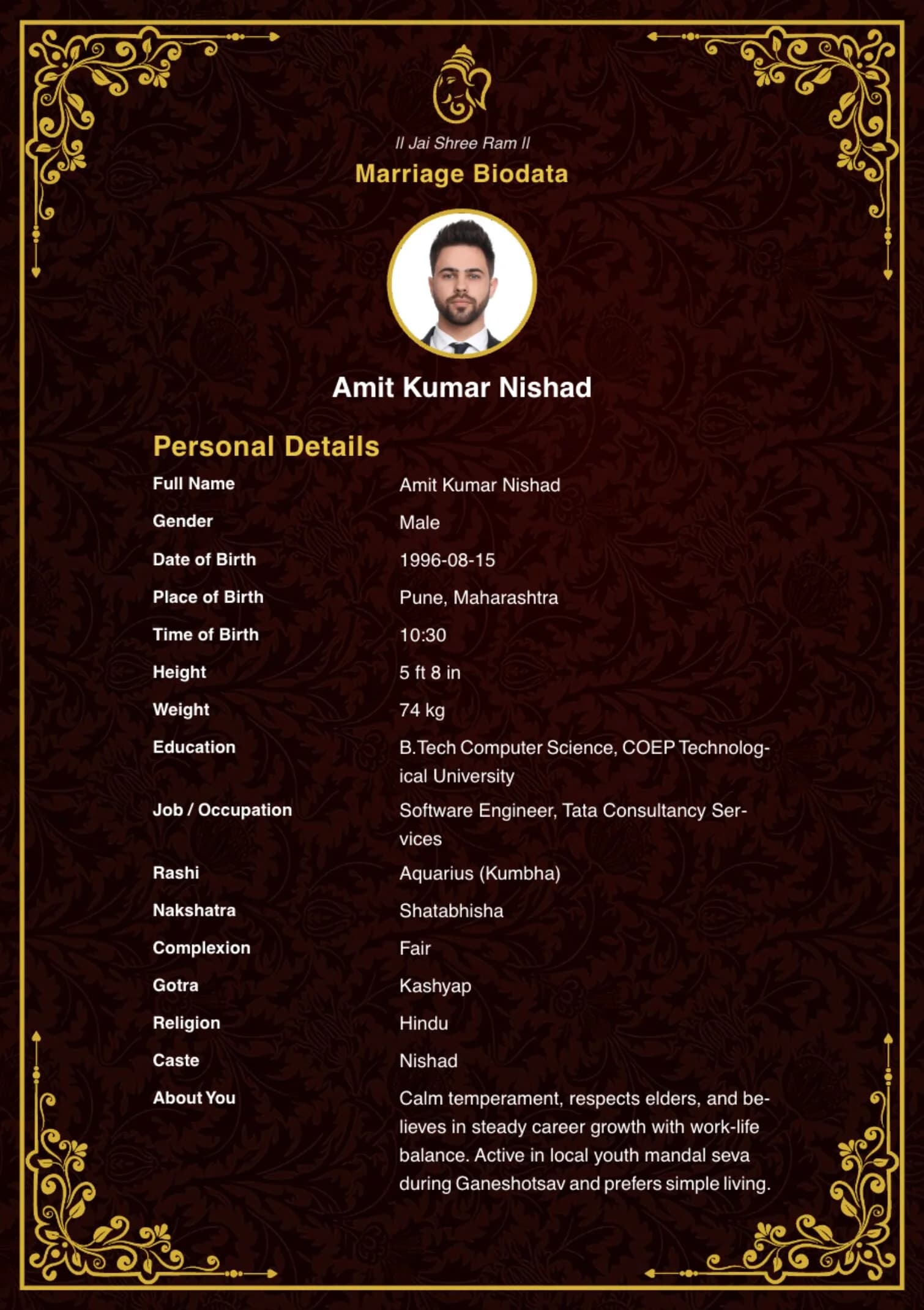 Royal Maroon
Default North Indian Hindu ceremonial biodata.
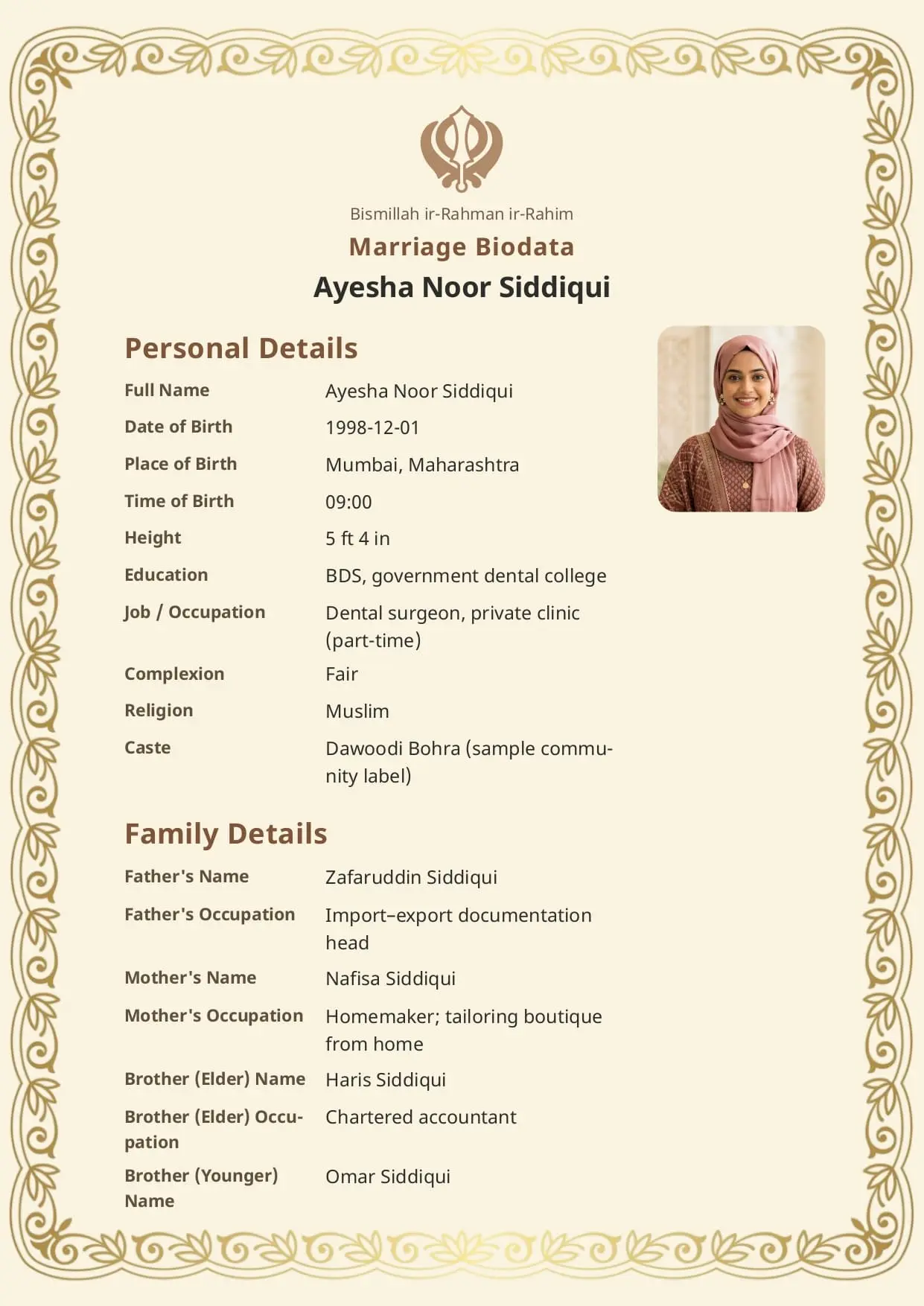 Classic Sandal
Cream heritage layout favoured in South India.
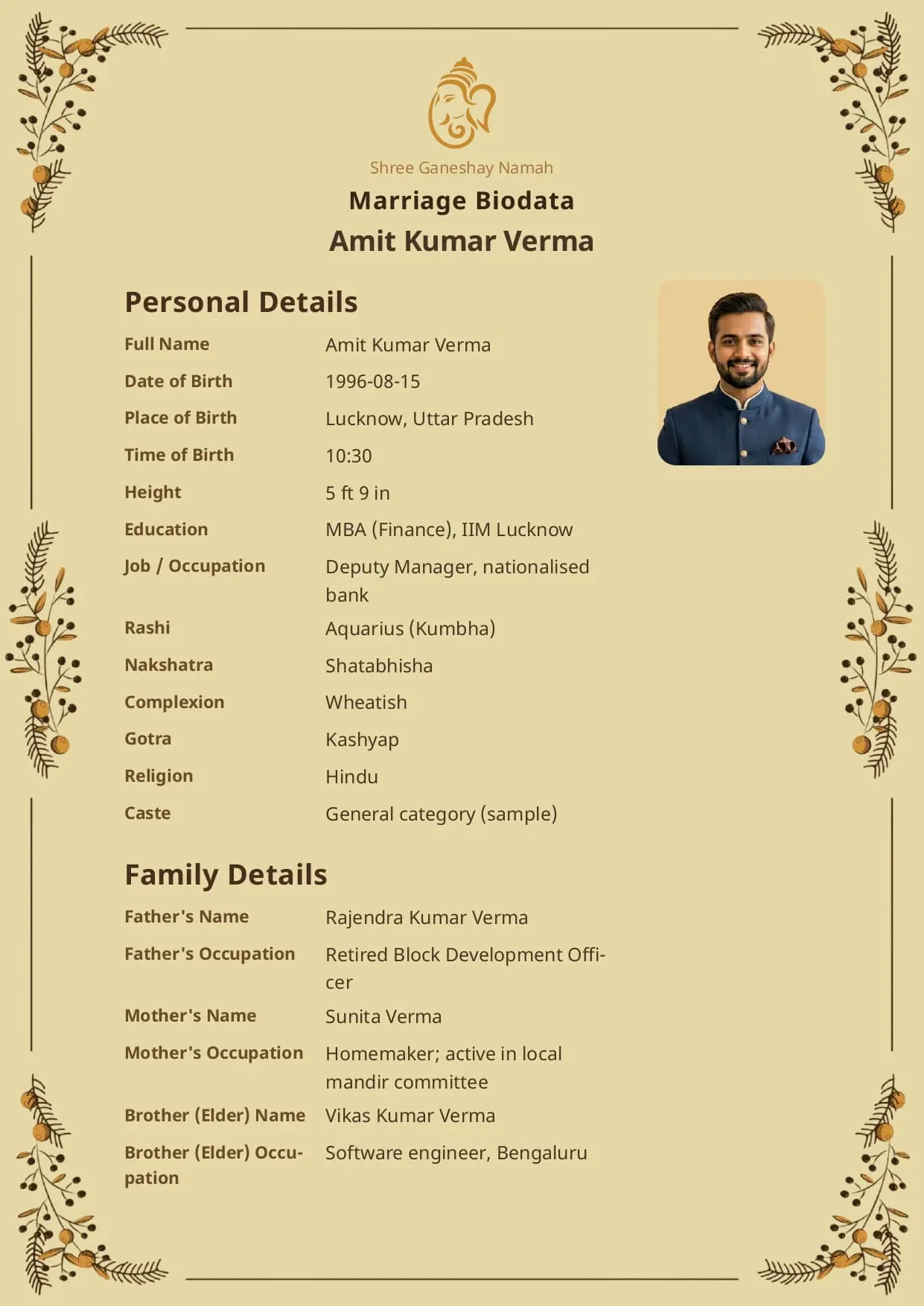 Vintage Gold
Ornate gold ivory for formal joint-family introductions.
Frequently asked questions
Is gotra required on a Hindu marriage biodata?
Many families include gotra and pravara for horoscope matching, but you decide what appears. Add them in custom fields if your elders expect it.
What horoscope details should I add?
Common entries are date of birth, time, place, rashi, nakshatra, and manglik status. Include only what your family uses for matching.
Can I use a Hindu biodata without religious symbols?
Yes. Choose a clean modern template for a neutral look, or a traditional maroon frame when relatives prefer a ceremonial Hindu presentation.
Should caste or sub-caste appear on the biodata?
That depends on your family's practice. BiodataBliss does not force caste fields — add community details only if you want them visible.
How do I list parents and siblings in Hindu format?
Use the family section for father's and mother's names, occupations, native place, and siblings. Preview to ensure the order reads naturally.